Bond Polarity is used to describe the sharing of electrons between atoms in covalent bonding. A polar covalent bond is a bond in which there is unequal sharing of electrons between atoms while a nonpolar covalent bond has equal sharing of electrons between atoms.
How can we distinguish between polar and nonpolar bond?
Electronegativity is a property of the elements used to determine if the sharing of electrons between atoms in covalent bonding is equal or not equal. Electronegativity is defined as the ability of an atom in a molecule to attract electrons to itself. The greater the electronegativity value the greater its ability to attracts electrons to itself.
The difference in electronegativity between atoms in a molecule is used to predict the sharing of electrons. Consider the example below:
Example 1.
Compound : F2
Electronegativity difference : 4.0 - 4.0 = 0
Type of Bond : Nonpolar covalent bond
Example 2
Compound : HF
Electronegativity difference : 4.0 - 2.1 = 1.9
Type of Bond : Polar covalent bond
Example 3.
Compound : LiF
Electronegativity Difference: 4.0 - 1.0 = 3.0
Type of Bond : Ionic Bond
The three examples above show how the type of bond be identified. In example 1, the difference between the electronegativity of two F atoms is 0, which is an indication that the sharing of electrons between atoms are equal. Therefore, a nonpolar covalent bond results when the electronegativity difference between atoms is from 0 to 0.4. In this difference of electronegativity still shows that the sharing of electrons is equal between atoms.
In example 2, we can see that the difference of electronegativity values between atoms is 1.9, this shows that the sharing of electrons is not equal. Therefore, a polar covalent bond results when the electronegativity difference between atoms ranges from 0.5 to 1.9. At this difference the sharing of electrons between atoms resulted in unequal sharing.
In example 3, the difference of electronegativity values between atoms is 3.0 which means that there is a big difference of electronegativity which resulted the transfer of electrons between one atom to another atom. Therefore, Ionic bond exist when the electronegativity difference is from 2.0 above.
Tuesday, September 5, 2017
Saturday, August 19, 2017
Covalent Bond
Covalent bond is another type of bond that involves the sharing of valence electrons between nonmetal atoms forming a molecule. Covalent compounds are the compounds that contains only covalent bonds. Examples of this are the diatomic molecules: H2, O2, N2.
To show the sharing of electrons between atoms in a molecule lewis structure must be written. A Lewis structure is a representation of covalent bonding in which shared electron pairs are shown either as line or pair of dots, and lone pairs are shown as pair of dots on the individual atoms. A line is used when electron pair is shared between atoms and dots are the unshared pair electrons.
In writing the Lewis structure, octet rule must also be followed and with a few exemptions.
Total valence electrons: 4 + 3 (6) + 2 = 4 + 18 + 2 = 24 valence electrons
Step 2. Arranging the atoms



To show the sharing of electrons between atoms in a molecule lewis structure must be written. A Lewis structure is a representation of covalent bonding in which shared electron pairs are shown either as line or pair of dots, and lone pairs are shown as pair of dots on the individual atoms. A line is used when electron pair is shared between atoms and dots are the unshared pair electrons.
In writing the Lewis structure, octet rule must also be followed and with a few exemptions.
Lewis Structure
There are rules to be followed when writing Lewis structure:
1. Add the total valence electrons from all atoms. For polyatomic anions, add the negative charges to the total number of valence electrons and for the polyatomic cations, subtract the positive charges from the total number of valence electrons.
2. Write the symbols of all the elements that comprise the molecule, arranging them in such a way that the central atom is the least electronegative atom or the atom with the least number of atoms. Example for the molecule CF4, C is the central atom having only one atom and F are the bonded atoms having 4 F atoms, F also is the most electronegative atom.
3. Draw a single covalent bond between the central atom and the surrounding atoms. Complete the 8 valence electrons of the bonded atoms and the excess valence electrons will be placed to the central atom and will represent the non-bonding electrons.
4. After completing step 1 - 3, if the central atom did not complete 8 number of valence electrons, try adding double bond or triple bond between the surrounding atoms and the central atoms.
Examples 1
Write the Lewis structure of the NF3
Step 1. Add the total number of valence electrons. Nitrogen is located in group VA therefore has 5 valence electrons and Flourine is in group VIIA , 7 valence electrons.
Total valence electrons: 5 + 3(7) = 5 + 21 = 26 valence electrons
Step 2. Arranging the atoms. the least electronegative atom is the central atom (N) and F are the bonded atoms.


Step 1. Calculate the total valence electrons. C has 4 valence electrons (IVA) and O has 6 valence electrons (VIA).1. Add the total valence electrons from all atoms. For polyatomic anions, add the negative charges to the total number of valence electrons and for the polyatomic cations, subtract the positive charges from the total number of valence electrons.
2. Write the symbols of all the elements that comprise the molecule, arranging them in such a way that the central atom is the least electronegative atom or the atom with the least number of atoms. Example for the molecule CF4, C is the central atom having only one atom and F are the bonded atoms having 4 F atoms, F also is the most electronegative atom.
3. Draw a single covalent bond between the central atom and the surrounding atoms. Complete the 8 valence electrons of the bonded atoms and the excess valence electrons will be placed to the central atom and will represent the non-bonding electrons.
4. After completing step 1 - 3, if the central atom did not complete 8 number of valence electrons, try adding double bond or triple bond between the surrounding atoms and the central atoms.
Examples 1
Write the Lewis structure of the NF3
Step 1. Add the total number of valence electrons. Nitrogen is located in group VA therefore has 5 valence electrons and Flourine is in group VIIA , 7 valence electrons.
Total valence electrons: 5 + 3(7) = 5 + 21 = 26 valence electrons
Step 2. Arranging the atoms. the least electronegative atom is the central atom (N) and F are the bonded atoms.
Step 3. Draw a single covalent bond between the central atom and the surrounding atoms. Complete the 8 valence electrons of the bonded atoms and the excess valence electrons will be placed to the central atom and will represent the non-bonding electrons.
Step 4. No more step 4 since all the atoms in the compound achieved stability by having eight valence electrons.
Example 2.
Write the Lewis structure of the carbonate ion, CO3-2
Total valence electrons: 4 + 3 (6) + 2 = 4 + 18 + 2 = 24 valence electrons
Step 2. Arranging the atoms
Step 3. Draw a single covalent bond between the central atom and the surrounding atoms. Complete the 8 valence electrons of the bonded atoms and the excess valence electrons will be placed to the central atom and will represent the non-bonding electrons.
Step 4. Since the central atom carbon is not yet stable, the two electrons from either of the oxygen can be made into double bond so the eight valence electrons in carbon will be meet. As shown below:
Example 3.
Draw the lewis structure of F2 gas.
Step 1. Calculate the total valence electrons of F2. 2(7) = 14 valence electrons
Step 2. Arranging the atoms. Since there are only 2 electrons, you can arrange them in linear form.
Step 3. Distribution of valence electrons, first a single bond will be placed in between the two fluorine atoms, the rest of electrons will be placed surrounding the F atom.
Step 4. Since each F atom, already achieved 8 valence electrons the structure above is already the lewis structure. If in case each atom will not achieve 8 valence electrons you can make double bond or triple bond between atoms.
TRY THIS:
Write the Lewis structure of the following:
1. SF6
2. PO3-3
3. CCl4
4. CO2
5. H2S
Wednesday, July 26, 2017
Ionic Bond
Ionic bond is a type of chemical bond that exist between metal and nonmetal forming an ionic compound which involves transfer of electrons. Metals having low in ionization energy and electronegativity, tends to lose their valence electrons to nonmetals. Nonmetals on the other hand accept valence electrons from metal due to their higher ionization energy and electronegativity.
Below is an example of ionic compound LiF:

Li has 1 valence electron while F has 7 valence electrons. To become stable the atoms should complete 8 valance electrons, but there are some exceptions that we have to consider.


 iv style="text-align: left;">
Below is an example of ionic compound LiF:
Complete transfer of electrons occur between metal and nonmetal when the electronegativity difference is 2.0 above. Just like the example above Li has electronegativiy of 1.0 and F has electronegativity of 4.0. Their difference is 3.0 therefore there is a complete transfer of valence electrons from Li to F.
Let us look at this:
Li has 3 electrons and F has 9 electrons with the electron configuration of:
Li = 1s2 2s1 and F = 1s2 2s2 2p5
Li has 1 valence electron while F has 7 valence electrons. To become stable the atoms should complete 8 valance electrons, but there are some exceptions that we have to consider.

The valence electrons of Li upon giving its 1 valence electron to F, is 2 from 1s2 configuration and the F will have the configuration of 1s2 2s2 2p6 , which has the valence electrons of 8.
As you can see the valence electrons now of Li upon giving its valence electron will be 2, same with the valence electrons of H which is exempted to the Octet Rule, therefore stable, and the F will have now 8 valence electrons achieving the octet rule. Therefore we can say that only one atom of Li is needed to make the F stable.
The formula now of Lithium flouride is LiF, having 1:1 ratio.
Let us have more examples:
The reaction between Calcium with Chlorine is also an example of ionic bonding, with electronegativity difference of 2.0 (3.0 -1.0) looking at their valence electrons and lewis symbols;
Calcium has 2 valence electrons being in group IIA and chlorine has 7 valence electrons being in group VIIA. The lewis symbol will be:

Since Ca has 2 valence electrons and Cl only need 1 valence electron, Ca will not be stable yet. And so we need more another Cl atom to make Ca stable as shown below:

Therefore to become stable, calcium will react with 2 atoms of chlorine, and will have a formula of CaCl2.
How about the reaction of Sr and N? Could there be a transfer of electrons? What is the electronegativity difference? Electronegativity difference of 2.0 ( 3.0 - 1.0) therefore transfer of electrons will occur. Sr is in group IIA having 2 valence electrons and N is in group VA having 5 valence electrons.

If we will only allow 1 Sr atom to react with 1 atom N, then both atoms will not be stable yet, so how many Sr is needed to react with N and vice versa. Lets find out:

Therefore to become stable Sr needs 3 atoms to 2 atoms of N. Chemical Formula is Sr3N2.
iv style="text-align: left;">
Monday, July 24, 2017
Chemical Bond
Chemical bond is an attraction that hold atoms together forming molecule and formula unit. There are three general types of bonds: the ionic, covalent and metallic.
Ionic bond refers to electrostatic attraction between ions of opposite charge, the cation and anion forming ionic compound. The bond is formed by transfer of electrons from metal to nonmetal. Further discussion about this on my next post.
Covalent bond is another type of bond which involve sharing of valence electrons between two nonmetals. The best example is the sharing of electrons of diatomic molecules like H2, O2, etc. Detailed discussion on my next post.
Metallic bond on the other hand is a bond that exist in metals such as aluminum, copper, and iron. In metals each atom is bonded to several neighboring atoms. The valence electrons in metallic bonding forms sea of valence electrons that are free to move throughout the three-dimensional structure of the metal.

Ionic bond refers to electrostatic attraction between ions of opposite charge, the cation and anion forming ionic compound. The bond is formed by transfer of electrons from metal to nonmetal. Further discussion about this on my next post.
Covalent bond is another type of bond which involve sharing of valence electrons between two nonmetals. The best example is the sharing of electrons of diatomic molecules like H2, O2, etc. Detailed discussion on my next post.
Metallic bond on the other hand is a bond that exist in metals such as aluminum, copper, and iron. In metals each atom is bonded to several neighboring atoms. The valence electrons in metallic bonding forms sea of valence electrons that are free to move throughout the three-dimensional structure of the metal.
Lewis Symbol
In chemical bonding, the one responsible are the valence electrons, the electrons occupying the highest energy level of an atom. We also learn that the valence electrons of representative elements are the same with the group number of the elements.
Now to easily understand covalent bonding, we need to learn how to write Lewis Symbol. Lewis symbol for an element consist of the chemical symbol for the element plus dots representing the valence electrons surrounding the chemical symbol. This Lewis symbol was formulated by an American Chemist G.N. Lewis (1875 - 1946) and now known as the Lewis electron-dot symbols or merely Lewis symbol.
Below are the Lewis symbol of Representative elements:

The Octet Rule
Why atoms undergo reaction? Do they want something? Yes, atoms want to become stable. Just like us we do something to our life to become stable financially, emotionally and more. Atoms became stable either by giving up, accepting or sharing their valence electrons. But atoms follow a certain rule to achieve stability. And what is that rule, and that's the Octet Rule. Octet Rule states that atoms gain stability by achieving 8 valence electrons same with the noble gases.
Exception of the Octet Rule
There are many exceptions to the Octet Rule, one of this are the elements consisting of less than 4 valence electrons located in the first and second period, will not complete the 8 valence electrons such as H, Li and B. There are also some elements that can have more that 8 valence electrons, those elements containing 5 or more valence electrons.

Sunday, July 23, 2017
Trends in Properties of the Elements in the Periodic Table
To know more about the different elements in the periodic table, you need to know the different properties of the elements and their trends. We need to recall that Periodic Table of Elements, the horizontal rows called periods and the vertical columns called groups or families.


Usually the atomic size increases from top to bottom and decreases from left to right in a given period. What could be the possible reason of this trend? As we move down a group, let's say from H to Fr the atomic size increases that is because of the addition of the energy level. What about in a given period where elements have the same energy level? The atomic number increases as we move from left to right in a given period, this means that the number of protons and electrons increases and therefore there is an increase in the effective nuclear charge, this is why the atomic size of the atoms decreases in moving from left to right in a given period.
Below are the radii (in picometers) of representative elements according to their position in the periodic table.

Plotting atomic size versus atomic number will give some repeating patterns. The elements in group IA are the elements on the highest point of the graph while elements in Group VIIA are the elements in the lowest point. This only indicates that atomic size decreases in a given a period from left to right.


Atomic Size
Atomic size refers to the how big or small an atom is. To determine the atomic size of an atom, atomic radius is used, which is a one-half the distance between the two nuclei in two adjacent metal atoms.
The first figure above shows the atomic radius of iodine diatomic molecule, the atomic radius is measured from the nucleus of the first atom of the iodine to the next atom of the molecule. The second figure shows how the atomic radius of two adjacent atoms is measured.
Below are the radii (in picometers) of representative elements according to their position in the periodic table.

Plotting atomic size versus atomic number will give some repeating patterns. The elements in group IA are the elements on the highest point of the graph while elements in Group VIIA are the elements in the lowest point. This only indicates that atomic size decreases in a given a period from left to right.

Ionization Energy
Ionization energy is another property of the elements, which is defined as the minimum energy required to removed an electron from a gaseous atom in its ground state. It is usually expressed in kJ/mol). The magnitude of the ionization energy is a measure of how tightly the electron is held in an atom. The higher the ionization energy, the more difficult it is to removed the valence electrons from an atom. For many atoms, the amount of energy required to remove the first electron from an atom is called first ionization energy.
The Ionization Energies of First 2 Elements in kJ/mol
What is the trend in ionization energies in going down a group and in moving from left to right in a given period? Let us see the graph below:
As we observed based from the graph above, the elements lie on the highest points are the elements in group VIIIA or group O/Noble Gases. And the elements lie on the lowest point of the graph are the elements in group IA/Alkali metals. Which means that in moving from left to right in a given period the ionization energy increases. therefore metals have lower ionization energies than nonmetals. This is the reason why metals tend to lose electrons forming cations or positive ions and nonmetals tend to gain electrons forming anions or negative ions. One reason also of the increase of the ionization energy from left to right is the increase of the nuclear attraction between the protons and valence electrons due to the decrease in the atomic size of the atoms.
In going down a group let say in Group IA from Li to Cs, there is a decrease in ionization energy. This means bigger atoms tend to lose electrons because of the lower nuclear attraction between the protons and the valence electrons.
Example :
1. Which has lower ionization energy Li or Rb? Na or Ar?
Answer: Rb has lower ionization energy than Li since Rb is bigger in size than Li. Na has lower ionization energy than Ar for the same reason.
Electron Affinity
Electron affinity is another property of elements which vary also in a group and within a given period. It is defined as the energy released when an atom accepts electrons from another atom forming anion.
Electrons Affinities of Some Representative Elements and Noble Gases in kJ/mol
From the above table, generally the electron affinity increases in moving from left to right in a given period. This means that nonmetals have higher electron affinity than metals. In going down a group the electron affinity is decreased.
Two sign conventions are used for electron affinity, it can be positive or negative. In most introductory text, the thermodynamic sign is used. A negative sign indicates that the addition of electrons is an exothermic process. Historically, however, electron affinity is defined as the energy released when an electron is added to a gaseous atom or ion, the electron by this convention is positive.
Two sign conventions are used for electron affinity, it can be positive or negative. In most introductory text, the thermodynamic sign is used. A negative sign indicates that the addition of electrons is an exothermic process. Historically, however, electron affinity is defined as the energy released when an electron is added to a gaseous atom or ion, the electron by this convention is positive.
Electronegativity
Electronegativity is another property of an element, it is defined as the ability of an atom to attract an electron to itself in relation to chemical bonding. The higher the value of electronegativity , the greater is the ability to attract electrons to itself. The electronegativity of an atom is related to ionization energy and electron affinity, which are also other properties of the elements. An atom with very negative electron affinity and high ionization energy will attract electrons more easily and resist having its electrons attracted away, and this is called highly electronegative atom.
Generally, electronegativity increases in moving from left to right in a given period, and decreases in moving down a group, as shown in Table below:

Since nonmetals have higher electronegativity values than metals, they have the ability to attract electrons than metals. That's the reason why nonmetals carries negative charge forming anion and metals form cation.
For general trends in the different properties of elements in the Periodic Table, refer on the table below:

Generally, electronegativity increases in moving from left to right in a given period, and decreases in moving down a group, as shown in Table below:

Since nonmetals have higher electronegativity values than metals, they have the ability to attract electrons than metals. That's the reason why nonmetals carries negative charge forming anion and metals form cation.
For general trends in the different properties of elements in the Periodic Table, refer on the table below:
Tuesday, July 18, 2017
Valence Electrons
What is valence electrons?
Valence means last, therefore valence electrons are the electrons located at the highest energy level. Valence electrons are the one responsible for chemical bonding and also responsible for the emission of light or energy.How do we determine the valence electrons of the elements?
There are two ways we can determine the valence electrons of an element, one of these is with the use of electron configuration. If you are using electron configuration, you need to determine the highest energy level and count the number of valence electrons found in the highest energy level. But these is only true for those Representative elements or the group A elements.
Let us have an example
1. H, atomic number is 1
Electron Configuration: 1s1
Since hydrogen has only one electron, therefore the valence electron of hydrogen is only 1.
2. He, atomic number is 2
Electronic Configuration: 1s2
Valence Electron : 2
Since helium has only one sublevel and orbital, valence electrons is 2.
3. F, atomic number = 9
Electron Configuration: 1s2 2s2 2p5
Valence electrons : 7
The valence electrons of Flourine is 7 , the highest energy level is 2 having two sublevels the s and p. Two electrons in 2s sublevel and 5 electrons in 2p sublevel, which equals 7 valence electrons. We need to add since both are in the same energy level.
4. Ca, atomic number = 20
Electronic Configuration: 1s2 2s2 2p6 3s2 3p6 4s2
Valence electrons: 2
5. Al, atomic number = 13
Electronic Configuration: 1s2 2s2 2p6 3s2 3p1
Valence electrons: 3
Let us have an example
1. H, atomic number is 1
Electron Configuration: 1s1
Since hydrogen has only one electron, therefore the valence electron of hydrogen is only 1.
2. He, atomic number is 2
Electronic Configuration: 1s2
Valence Electron : 2
Since helium has only one sublevel and orbital, valence electrons is 2.
3. F, atomic number = 9
Electron Configuration: 1s2 2s2 2p5
Valence electrons : 7
The valence electrons of Flourine is 7 , the highest energy level is 2 having two sublevels the s and p. Two electrons in 2s sublevel and 5 electrons in 2p sublevel, which equals 7 valence electrons. We need to add since both are in the same energy level.
4. Ca, atomic number = 20
Electronic Configuration: 1s2 2s2 2p6 3s2 3p6 4s2
Valence electrons: 2
5. Al, atomic number = 13
Electronic Configuration: 1s2 2s2 2p6 3s2 3p1
Valence electrons: 3
Relationship Between the Valence Electrons and the Group Number
Representative elements (Elements from group IA to group VIIIA now group 0) valence electrons are related to their group number. Based from the examples above, Hydrogen being in group IA has 1 valence electron, Flourine in group VIIA has 7 valance electrons, Calcium in group IIA has 2 valence electrons and aluminum group IIIA has 3 electrons. Except helium which is an exception. In other words, valence electron is just equal to the group number of elements in Representative group of elements but not related to transition elements.
Below are some examples of elements:


Sunday, July 2, 2017
Electron Configuration
Electron configuration is the arrangement of electrons in successive sublevels and orbitals. To determine the electron configuration of the elements electron distribution mnemonics is used.


In the electron distribution mnemonics the sublevels are already arranged according to increasing energy as shown below:
1s 2s 2p 3s 3p 4s 3d 4p 5s 4d 5p 6s 4f 5d 6p 7s 5f 6d 7p
Now in writing electronic configuration we have to follow the Pauli's Exclusion Principles which states that, no two electrons can have four quantum numbers, and that orbitals can only accommodate 2 electrons with opposite spins. Since, we only have 1 s orbital in s sublevel, only two electrons can occupy in s sublevel, and we have 3 p orbitals in p sublevel, and therefore total of 6 electrons can be accommodated in p sublevel. In d sublevel there are 5 d orbitals, accommodating 2 electrons in each orbital there are 10 total electrons that can be accommodated in d sublevel, and in f sublevel there are 7 f orbitals and having 2 electrons each orbital, total of 14 electrons are in sublevel f. An so we have to take note in writing electrons configuration the following: s can have only 1 or two electrons, p can have only 1 to 6 electrons, d can have 1 to 10 electrons, and f sublevels can have 1 to 14 electrons.
We use atomic number in writing the electron configuration, since atomic number is the number of protons at the same time the number of electrons. Let us have an example:
What is the electron configuration of first 10 elements?
1H has only 1 electron and so the the electron is only located at the lowest sublevel 1s. The electron configuration is : 1s1
2He has 2 electrons. The electron configuration is 1s2
3Li : 1s2 2s1
4Be: 1s2 2s2
5B : 1s2 2s2 2p1
6C : 1s2 2s2 2p2
7N : 1s2 2s2 2p3
8O : 1s2 2s2 2p4
9F : 1s2 2s2 2p5
10Ne : 1s2 2s2 2p6
We have to take note that in writing electron configuration, electron distribution mnemonics must be followed.
Saturday, June 24, 2017
Energy Levels, Sublevels and Atomic orbitals
Based from the flame test, Neils Bohr compared the model of an atom with that of the solar system. The nucleus of an atom is comparable to the sun the center of the atom and the energy levels are comparable to the orbits and the electrons are comparable to the planets. Energy levels of an atom is where the electrons occupy. Based from the Periodic Table of elements the biggest atom has 7 energy levels. This principal energy levels of the atom has corresponding energy based from Bohr Theory, and and also composed of different sublevels and with different kind of orbitals. As the energy level increases the energy required also increases.
Below is a table showing the different principal energy levels with their corresponding sublevels, orbitals and number of electrons:

As you will notice the number of sublevels are just the same as the number of energy levels, and that the name of the sublevels are also the same as the name of orbitals. In determining the number of orbitals n2 is used, where n represents the energy level and the maximum number of electrons can be determined using 2n2, where n is also the number of energy levels.
The sublevels are 1s, 2s, 2p, 3s, 3p, 3d, 4s, 4p, 4d, 5s, 5p, 5d, 5f, and 5g. The last sublevel the 5g is not yet existing in the modern periodic table There are also sublevels in 6th and 7th energy levels which will be shown below. These sublevels are not yet arranged according to their energies, the electrons distribution mnemonics found in the periodic table arranged the different sublevels according to increasing energy.

Below is a table showing the different principal energy levels with their corresponding sublevels, orbitals and number of electrons:
As you will notice the number of sublevels are just the same as the number of energy levels, and that the name of the sublevels are also the same as the name of orbitals. In determining the number of orbitals n2 is used, where n represents the energy level and the maximum number of electrons can be determined using 2n2, where n is also the number of energy levels.
The sublevels are 1s, 2s, 2p, 3s, 3p, 3d, 4s, 4p, 4d, 5s, 5p, 5d, 5f, and 5g. The last sublevel the 5g is not yet existing in the modern periodic table There are also sublevels in 6th and 7th energy levels which will be shown below. These sublevels are not yet arranged according to their energies, the electrons distribution mnemonics found in the periodic table arranged the different sublevels according to increasing energy.

The above electron distribution mnemonics can be used to write electron configuration and is already arranged according to increasing energy. There is an overlapping in some sublevels, example 4s come first before 3d. This is the arrangement following the above Mnemonics:
1s 2s 2p 3s 3p 4s 3d 4p 5s 4d 5p 6s 4f 5d 6p 7s 5f 6d 7p
Saturday, June 17, 2017
Flame Test
We know that atom is composed of three fundamental particles, the proton, electron and neutron. And that the protons and neutrons are located inside the nucleus and electrons are found outside the nucleus. Have you seen fireworks display? What are the colors produced? Yes different colors are produced in fireworks display. What fundamental particle is responsible for the color of the fireworks display? Its the electrons and every element has its unique color of the flame.
Flame test is used to determine the elements present in a compound, because every element emits unique color of the flame which is used to identify the elements. Below are some elements with their corresponding flame color.
boron -green
calcium - orange
sodium - yellow orange
potassium - light violet
copper - blue-green
barium - pale green
lithium - red
magnesium - white sparks
iron - yellow sparks
arsenic - blue
cesium - blue
copper (I) - green
strontium - crimson
thallium - pure green
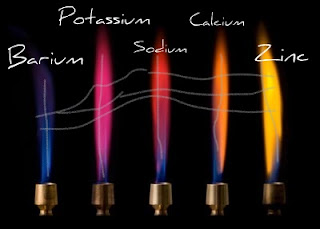


Flame test is used to determine the elements present in a compound, because every element emits unique color of the flame which is used to identify the elements. Below are some elements with their corresponding flame color.
boron -green
calcium - orange
sodium - yellow orange
potassium - light violet
copper - blue-green
barium - pale green
lithium - red
magnesium - white sparks
iron - yellow sparks
arsenic - blue
cesium - blue
copper (I) - green
strontium - crimson
thallium - pure green

How does the flame color produced?
How does the color of the flame produced? What happens inside the metal atom? As the metal atom is heated the electrons outside the nucleus are the ones that receive the heat, electrons then jump to higher energy level upon absorption of heat. As the electron jumps to higher energy level, the electron is said to be in the excited state, and in that state the electron becomes unstable, the tendency the electron will go back to lower energy levels emitting the excess energy in the form of light. And this was the basis of Neil's Bohr Model of an atom.
Monday, June 12, 2017
Chemical Formula
Chemical formula shows the kind and number of atoms present in molecules or ionic compounds. Knowing the formula of a compound, you can determine the number of atoms and kinds of atoms present in a compound. For example, the formula of water, H2O, will give you an information that there are 2 atoms of hydrogen and only one atom of oxygen, meaning the ratio of the elements also is shown in chemical formula.
Chemical formula can be molecular formula and empirical formula. Molecular formula shows the exact number of atoms of each element in a molecule. Empirical formula shows the simplest ratio of elements in a compound or molecule.
A. Binary compounds
In writing the chemical formula of binary compounds you have to follow the rules below:
1. Identify the monoatomic cation and monoatomic anion that are present in a compound. Example, magnesium chloride, this compound is composed of magnesium ion and chloride ion or chlorine ion. Start by writing the symbol of cation (positive ion) and followed by the symbol of anion (negative ion).
Mg+2 Cl-1
2. In writing chemical formula, the total charge must be equal to zero. To balance the charges between the 2 ions above, the best way is to use the "criss cross process", which means that the oxidation number of the cation will be the subscript of the anion, and the oxidation number of the anion will be the subscript of the cation, disregarding the sign of the numbers.
Mg1+2 Cl2-1
Analyzing the charges, magnesium will have +2 charge and the chlorine will have -2, with a total charge equal to 0.
Finalizing the formula, we have:
MgCl2
B. Ternary Compounds
In ternary compound, it has the same rules as that of binary compound, only that parenthesis is used for polyatomic ions having 2 or more subscript.
1. Identify the monoatomic or polyatomic cations so as the anions. Also write the symbol or fomula of the cation followed by the anion. For example the compound Iron (III) sulfate, it is composed of iron having +3 oxidation number and sulfate ion (SO4-2).
Fe+3 SO4-2
2. The same as that of the binary compound, the charge of the chemical formula of ternary compound must be equal to zero. So, to balance the charges the crisscross process also will be used. The oxidation of iron which is 3 will be the subscript of sulfate and the oxidation of sulfate will be the subscript of iron.
Fe2+3 SO4 3-2
Analyzing the charges, Fe will have a charge of +6 and sulfate will have -6, with a total charge of 0.
In writing chemical formula, polyatomic ion, although composed of 2 or more elements, just act as one in chemical formula writing, therefore the subscript 3 must not only belong to oxygen but also for sulfur, to do so parenthesis is used, as shown below:
Fe2(SO4)3
If the subscript of the polyatomic ion is equal to one, it is not written because absence of subscript means one. On the other hand, parenthesis also should not be written if the subscript is equal to 1.
Since writing chemical formulas involve balancing the charges between the cation and anion, once the charge is already equal, no subscript is added to both cation and anion. Like for example the compound calcium carbonate, composed of calcium ion and carbonate ion.
Ca+2 CO3-2
Since both have the same oxidation number, meaning the charge is already equal, the formula will be
CaCO3
Chemical formula can be molecular formula and empirical formula. Molecular formula shows the exact number of atoms of each element in a molecule. Empirical formula shows the simplest ratio of elements in a compound or molecule.
Rules in Writing Chemical Formula
Compounds can be binary compounds consisting only of 2 elements combined chemically, and ternary compounds composed of 3 or more elements chemically combined. Example of binary compound is NaCl composed only of sodium and chlorine; while CaCO3 is an example of ternary compound composed of calcium, carbon and oxygen elements,A. Binary compounds
In writing the chemical formula of binary compounds you have to follow the rules below:
1. Identify the monoatomic cation and monoatomic anion that are present in a compound. Example, magnesium chloride, this compound is composed of magnesium ion and chloride ion or chlorine ion. Start by writing the symbol of cation (positive ion) and followed by the symbol of anion (negative ion).
Mg+2 Cl-1
2. In writing chemical formula, the total charge must be equal to zero. To balance the charges between the 2 ions above, the best way is to use the "criss cross process", which means that the oxidation number of the cation will be the subscript of the anion, and the oxidation number of the anion will be the subscript of the cation, disregarding the sign of the numbers.
Mg1+2 Cl2-1
Analyzing the charges, magnesium will have +2 charge and the chlorine will have -2, with a total charge equal to 0.
Finalizing the formula, we have:
MgCl2
B. Ternary Compounds
In ternary compound, it has the same rules as that of binary compound, only that parenthesis is used for polyatomic ions having 2 or more subscript.
1. Identify the monoatomic or polyatomic cations so as the anions. Also write the symbol or fomula of the cation followed by the anion. For example the compound Iron (III) sulfate, it is composed of iron having +3 oxidation number and sulfate ion (SO4-2).
Fe+3 SO4-2
2. The same as that of the binary compound, the charge of the chemical formula of ternary compound must be equal to zero. So, to balance the charges the crisscross process also will be used. The oxidation of iron which is 3 will be the subscript of sulfate and the oxidation of sulfate will be the subscript of iron.
Fe2+3 SO4 3-2
Analyzing the charges, Fe will have a charge of +6 and sulfate will have -6, with a total charge of 0.
In writing chemical formula, polyatomic ion, although composed of 2 or more elements, just act as one in chemical formula writing, therefore the subscript 3 must not only belong to oxygen but also for sulfur, to do so parenthesis is used, as shown below:
Fe2(SO4)3
If the subscript of the polyatomic ion is equal to one, it is not written because absence of subscript means one. On the other hand, parenthesis also should not be written if the subscript is equal to 1.
Since writing chemical formulas involve balancing the charges between the cation and anion, once the charge is already equal, no subscript is added to both cation and anion. Like for example the compound calcium carbonate, composed of calcium ion and carbonate ion.
Ca+2 CO3-2
Since both have the same oxidation number, meaning the charge is already equal, the formula will be
CaCO3
Sunday, June 4, 2017
Circulatory System
Circulatory system is the life support structure that delivers oxygen and nutrients to the cells of the different parts of the body and also transport waste away from the body. It is composed of three major parts the heart, blood, and blood vessels.
Blood - carries oxygen, and nutrients to the different parts of the body.
Blood vessels - carries the blood throughout the body. Blood vessels are classified as:

The three major parts of the circulatory system and their functions:
Heart - pumps blood throughout the body.Blood - carries oxygen, and nutrients to the different parts of the body.
Blood vessels - carries the blood throughout the body. Blood vessels are classified as:
- Arteries -carry oxygenated blood away from the heart to the cells, tissues and organs of the body.
- Veins - carry deoxygenated blood back to the heart.
- Capillaries - are very tiny blood vessels that form a connection between arteries and veins. This is where the exchange of gases occur.
Types of Circulation
- Pulmonary circulation - is the movement of the blood from the heart to the lungs and back to the heart.
- Coronary circulation - is the movement of the blood through the tissues of the heart.
- Systemic circulation - is the movement of the blood from the heart to the different parts of the body excluding the lungs.
The Human Heart
The heart is a muscle that is the same size of your fist. It has four chambers, each chamber has corresponding function. These are the right atrium, left atrium, right ventricle and left ventricle.
The right atrium receives the deoxygenated blood from the different parts of the body; the left atrium, receives the blood from the lungs; the right ventricle, pumps the blood to the lungs; the left ventricle, pumps the blood to the different parts of the body.
There is a valve between atria and ventricles, to prevent the blood from flowing backwards. The valves are like one-way doors that keep the blood from moving in one direction. Valves control movement of blood into the heart chambers and out into aorta and pulmonary artery.


Valves of the Heart
- Tricuspid valve - is located between right atrium and right ventricle
- Pulmonary valve- is located between the right ventricle and pulmonary artery
- Mitral valve - is located between the left atrium and left ventricle
- Aortic valve is located between the left ventricle and the aorta
How the heart works
The right atrium receives the blood from the different parts of the body, and will pass to the right ventricle in which is the once responsible of pumping the blood to the lungs. From the lungs the blood will again go back to the heart entering in the left atrium and to the left ventricle, and then it will be pump to the different parts of the body, and will then again go back to the heart for another cycle.
Wednesday, May 31, 2017
Respiratory System
Respiratory system is composed of different organs in our body that are responsible for breathing. Breathing is a process of taking in oxygen and expelling carbon dioxide from our body. The parts of the respiratory system that are responsible of supplying oxygen are nose, nasal passages, trachea, bronchi, lungs and diaphragm.

Different Parts of Respiratory System and their Function
Nose and nasal cavity is the organ through which the air enters and filtered. The hair that line the inside wall are part of the air cleansing system.
Pharynx collects incoming air from the nose and passes it downward to the trachea (windpipe).
Epiglottis is a flap of tissue that guards the entrance to the trachea. It closes when anything is swallowed that should go into the esophagus and stomach.
Larynx (voice box) contains the vocal cords. When moving air is breathed in and out, it creates voice sounds.
Trachea (windpipe) is the passage way of air into the lungs.
Bronchi are two branching tubes that connects the trachea to the lungs. The bronchial tubes are line with cilia (like very small hairs) that have a wave-like motion. The motion carries mucus (sticky phlegm or liquid) upward and out into the throat, where it is either coughed or swallowed. The mucus catches and holds much of the dust, germs and other unwanted matters that harms the lungs. The lungs get rid of the mucus through coughing.
Bronchioles is the finer subdivision of bronchi, hairlike tubes that connect to the alveoli.
Alveoli are also called air sacs, it is where the gas exchange occurs. Each of the air sacs is covered by tiny blood vessels called capillaries.The capillaries are connected to a network of arteries and veins that move blood through your body.
Diaphragm is a strong wall of muscles that separates the chest cavity from the abdominal cavity. It is the main muscles used for breathing. The diaphragm expand and contract the thoracic cavity, causing the lungs to expand and contract.

THE RESPIRATORY SYSTEM
How Does Respiratory System Works
The air enters through the nose, where it is filtered and to the nasal passages where gas is warmed and moistened. Then to the windpipe or trachea and down to the bronchi and to the bronchioles and to the alveoli. In the alveoli the oxygen is diffused through the capillaries and to the heart. On the other hand, carbon dioxide is also diffused from the capillaries in the alveoli to the bronchioles and out of the lungs to the bronchi, trachea and passes out from the nose.
Monday, May 29, 2017
Colligative Properties of Solution
Colligative properties of solution are properties of solution that depend on the amount of solute present in the solution and not on the nature of solute particles. These are the vapor-pressure lowering, boiling-point elevation, freezing-point depression, and osmotic pressure.
For example, the vapor pressure of pure water at 20oC is 17.5 torr. What if glucose (C6H12O6) is added to water. Let us say the mole fraction of water, XH2O = 0.800 and mole fraction of glucose, XC6H12O6 = 0.200. What is the vapor pressure of the solution? Calculating the problem:
Freezing point = (normal freezing point of solvent + ∆Tb
= 0.0 oC - 10.0 oC = -10.0 oC

The osmotic pressure of a solution is given by:

Vapor-pressure Lowering
Some liquids like water contains molecules, these molecules when absorb enough energy will eventually form into vapor. The pressure exerted by the vapor is called vapor pressure. Try boiling water in whistling tea kettle, you will notice that when it boils the tea kettle whistle, this is because of the pressure caused by the vapor. What will happen to the vapor pressure when solute is added to the solvent? Since solution contains already solute that is attached to the solvent, the vapor pressure of the solution is lower compared to the pure solvent. The relationship is expressed by Rault's Law, which states that the partial pressure of a solution, PA, equals the product of the mole fraction of the solvent in the solution, XA, times the vapor pressure of the pure solvent, PoA.
PA = XA PoA
For example, the vapor pressure of pure water at 20oC is 17.5 torr. What if glucose (C6H12O6) is added to water. Let us say the mole fraction of water, XH2O = 0.800 and mole fraction of glucose, XC6H12O6 = 0.200. What is the vapor pressure of the solution? Calculating the problem:
PH2O = XH2O PoH2O
= (0.800)(17.5 torr)
= 14.0 torr
Based from the calculation above, there is a decrease in vapor pressure from 17.5 torr of pure solvent to 14 torr of vapor pressure of the solution.
Sample Problem:
Calculate the vapor pressure of a solution made by dissolving 218 g of glucose (molar mass = 180 g/mol) in 460 mL of water at 30oC. What is the vapor pressure lowering? The vapor pressure of water at 30oC is 31.82 mm Hg. Assume the density of the solution is 1.00 g/mL.
Solution:
First, calculate the number of moles of glucose and water.

Then, the mole fraction of water, X1(water) is

For the vapor pressure of the solution, we have,
PA = XA PoA
Psolution = (0.955) (31.82 mm Hg)
= 30.4 mm Hg
Therefore the vapor pressure lowering is 31.82 mm Hg - 30.4 mm Hg = 1.4 mm Hg


Sample Problem:
Automotive antifreeze consists of ethylene glycol (C2H6O2), a nonvolatile nonelectrolyte. Calculate the boiling point and freezing point of a 25.0 mass % solution of ethylene glycol in water.
Solution:
The given in the problem is 25 % by mass of ethylene glycol solution. Let us assume an amount of solution let say 1000 g of the solution. Since the solution is 25 % by mass, this means that 250 g of ethylene glycol is in 750 g of water. Using this quantities we can calculate the concentration of the solution in molality:

After calculating the molality, boiling point elevation and freezing point depression can now be calculated:
∆Tb = Kbm = (0.51 oC/m)(5.37 m) = 2.7 oC
∆Tf = Kf m = (1.86 oC/m)(5.37 m) = 10.0 oC
Sample Problem:
Calculate the vapor pressure of a solution made by dissolving 218 g of glucose (molar mass = 180 g/mol) in 460 mL of water at 30oC. What is the vapor pressure lowering? The vapor pressure of water at 30oC is 31.82 mm Hg. Assume the density of the solution is 1.00 g/mL.
Solution:
First, calculate the number of moles of glucose and water.
Then, the mole fraction of water, X1(water) is
For the vapor pressure of the solution, we have,
PA = XA PoA
Psolution = (0.955) (31.82 mm Hg)
= 30.4 mm Hg
Therefore the vapor pressure lowering is 31.82 mm Hg - 30.4 mm Hg = 1.4 mm Hg
Boiling Point Elevation
Boiling point is the temperature at which the vapor pressure equalizes with the atmospheric pressure. Since the vapor pressure of the solution is lowered than its pure solvent, therefore the boiling point also of the solution is affected with the presence of the solute. Below is the phase diagram illustrating the boiling point elevation and freezing point depression of aqueous solution:
Based from the graph above, the boiling point of solution is higher than that of the boiling point of pure water. The increase in boiling point is due to the solute present in the solution. The normal boiling point of pure liquid is the temperature at which its vapor pressure equals 1 atm. Since vapor pressure of the solution is lowered , it requires higher temperature to attain vapor pressure of 1 atm. Thus, the boiling of the solution is higher than that of the pure liquid.
The increase in boiling point relative to that of the pure solvent, is directly proportional to the number of solute particles per mole of solvent molecules, meaning directly proportional to the concentration expressed in molality. Thus,
∆Tb = Kbm
where ∆Tb is boiling point elevation, m is molality of the solution, and Kb is the molal boiling-point elevation constant. The unit of Kb is oC/m.
Below is a table showing the Molal Boiling-Point Elevation and Freezing-Point Depression Constants:
Freezing-Point Depression
Freezing-point of a solution is the temperature at which the first crystals of pure solvent begin to form equilibrium with the solution. Based from the graph above, the freezing point of the solution is lower than that of the pure liquid. This is because freezing involves a transition from disordered to ordered state wherein, energy must be removed from the system in order the process to occur. Because solution has greater disorder than the solvent, more energy is needed to be removed from it in order to create order the same as that of the pure solvent.
The freezing point depression, ∆Tf, is directly proportional to the molality of the solute:
∆Tf = Kf m
where, m is the concentration of the solute in molality, Kf is the molal freezing-point depression constant. The unit also is oC/m.
Sample Problem:
Automotive antifreeze consists of ethylene glycol (C2H6O2), a nonvolatile nonelectrolyte. Calculate the boiling point and freezing point of a 25.0 mass % solution of ethylene glycol in water.
Solution:
The given in the problem is 25 % by mass of ethylene glycol solution. Let us assume an amount of solution let say 1000 g of the solution. Since the solution is 25 % by mass, this means that 250 g of ethylene glycol is in 750 g of water. Using this quantities we can calculate the concentration of the solution in molality:
∆Tb = Kbm = (0.51 oC/m)(5.37 m) = 2.7 oC
∆Tf = Kf m = (1.86 oC/m)(5.37 m) = 10.0 oC
boiling point = (normal boiling point of solvent) + ∆Tb
= 100 oC + 2.7 oC = 102.7 oC
= 100 oC + 2.7 oC = 102.7 oC
Freezing point = (normal freezing point of solvent + ∆Tb
= 0.0 oC - 10.0 oC = -10.0 oC
Osmotic Pressure
Osmosis is the net movement of solvent molecules through semipermeable membrane from dilute solution to a concentrated solution. Semipermeable membrane is a membrane that allows the passage of solvent molecules but block the passage of solute molecules. Let us look at the figure below:
The figure above, a is a container containing the same amount of pure solvent and solution separated by a semi permeable membrane. The left part contains the pure solvent while the right part contains the solution. In container b, osmosis occurs, the solution part rises, this is because the solvent in the left compartment passes through the semipermeable membrane . Osmotic pressure is equal to the hydrostatic pressure exerted by the column of fluid in the right tube at equilibrium.
Osmotic pressure 𝝅 of the solution is the pressure required to stop osmosis. The osmotic pressure of a solution is given by:
𝝅 = MRT
where M is the molarity of the solution, R is the gas constant (0.0821 L.atm/K.mol) and T is the absolute temperature. The osmotic pressure, 𝝅, is expressed in atmospheres.
Osmotic pressure, the same with other colligative properties, is directly proportional to the concentration of solution. This means that all colligative properties of solution are dependent on the number of particles of solute present in the solution. If two solutions have the same concentration and osmotic pressure, they are said to be isotonic. If two solutions have different osmotic pressure, the more concentrated solution is said to be hypertonic, and the more dilute solution is said to be hypotonic.

Osmosis plays a vital role in living systems. Example, the membrane of red blood cells are semipermeable. When red blood cells is placed in a solution that is hypertonic relative to the intracellular solution (the solution within the cells) causes water to move out of the cell. This causes the cell to shrivel, a process called crenation. Placing the cell in a solution that is hypotonic relative to the intracellular fluid causes water to move into the cell. This causes the cell to rupture, a process called hemolysis. Some patients who need body fluids or nutrients replaced but cannot be done orally are given solutions by intravenous (IV) infusion, which feeds nutrients directly into the veins. To prevent crenation or hemolysis of red blood cells , the IV solutions must be isotonic with the intracellular fluids of the cells.
There are many interesting examples of osmosis, one of these is watering of plants. Water moves from soil into plant roots and into the upper portions of the plants. But if you will use seawater in watering the plants, the reverse will occur. The water from the plant will flow down into the roots into the soil, this will cause the dehydration of plant. This is because in osmosis the water moves from less concentrated to the more concentrated solution.
Sample Problem:
The average osmotic pressure of blood is 7.7 atm at 25oC. What concentration of glucose (C6H12O6) will be isotonic with blood?
Solution:
The given above are the osmotic pressure and the temperature. Temperature must be converted to K before calculating.
𝝅 = MRT

Solution:
The given above are the osmotic pressure and the temperature. Temperature must be converted to K before calculating.
𝝅 = MRT
Monday, May 22, 2017
Concentration of Solution
Concentration is defined as the amount of solute present in a given amount of solvent. It can be expressed qualitatively and quantitatively. The qualitative way of expressing the concentration is either diluted or concentrated. A concentrated solution contains more solute in the solution while diluted solution contains less solute in the solution. Very sweet sugar solution is an example of concentrated solution while sugar solution with little sweetness is an example of diluted solution.
There are many different ways in which we can express concentration quantitatively; some are these are the following: percent by mass, percent by volume, molarity, and molality.
Percent by Mass
Percent by mass (% by mass) is defined as the mass of the solute per mass of solution multiplied by 100. In formula it can be written as


There are many different ways in which we can express concentration quantitatively; some are these are the following: percent by mass, percent by volume, molarity, and molality.
Percent by Mass
Percent by mass (% by mass) is defined as the mass of the solute per mass of solution multiplied by 100. In formula it can be written as
The formula above can be used when the given in the problem are the mass of the solute and the mass of the solution. But if the given in the problem are the mass of solute and mass of solvent, you can use this formula:
Sample Problem 1.
A solution is made by dissolving of 13.5 g of glucose in 100 g of water. What is the mass percentage of solute in this solution?
Solution:
Given:
13.5 g of glucose, mass of solute
100 g of water, mass of the solvent
Formula and calculation:
Sample Problem 2.
What is the percent by mass of the solution when 5.50 g of NaBr is dissolved in 78.2 g of solution?
Solution:
Given:
5.50 g of NaBr, mass of solute
78.2 g of solution, mass of solution
Formula and calculation:
Percent by Volume
Percent by volume is just the same with that of percent by mass, only that volume of the substance is being used. Percent by volume can also be calculated using the formula below:
Sample Problem 1.
What is the percent by volume of the solution when it contains 27 mL of alcohol in 100 mL of solution?
Solution:
Given:
27 mL alcohol, volume of solute
100 mL solution, volume of solution
Formula and calculation:
Degree Proof
Degree Proof is another measure of concentration related to percent by volume. It is twice the percent by volume.
This means that an 80 degree proof liquor contains 40 % of alcohol by volume. The table below shows the alcohol content of some alcoholic drinks:
Molarity
Molarity (M) is also known as molar concentration, it refers to the number of moles of solute per liter of solution.
The unit of molarity is mole per liter (mol/L) or simply M.
Sample Problem 1.
What is the molarity of an 85 mL ethanol (C2H5OH) solution containing 1.77 g of ethanol?
Solution:
Given:
1.77 g of ethanol
85 mL of solution = 0.085 L solution
To calculate molarity the number of moles of solute must be calculated, and to calculate the number of moles the molar mass of ethanol should also be calculated first.
Molar mass of ethanol
C = 2 x 12 = 24 g
H = 6 x 1 = 6 g
O = 1 x 16 = 16 g
46 g/mol
Number of moles can be calculated by dividing the given mass to its molar mass.
To calculate the molarity
Molality
Molality (m) is also called molal concentration is the number of moles of solute per kilogram of solvent. The unit of molality is mol/kg or m.
Sample Problem:
A solution is made by dissolving 4.35 g of glucose (C6H12O6) in 25.0 kg of water. Calculate the molality of glucose in the solution.
Solution:
Given:
4.35 g glucose
25.0 g of water = 0.025 kg water
We need to calculate the molar mass of glucose (C6H12O6), before we can calculate the number of moles.
C = 6 x 12 = 72 g
H =12 x 1 = 12 g
O = 6 x 16 = 96 g
180 g
moles of solute can also be calculated using factor label method as shown below:
For more Sample Problems click HERE
Subscribe to:
Posts (Atom)